
Contractor Legislation in 2026: Are you at risk?
13 Mar, 20269 minutes

Contractor legislation continues to evolve, and with increasing HMRC scrutiny, organisations must understand their responsibilities when engaging contractors.
To support this, we hosted a webinar, “Contractor Legislation Unpacked: IR35, Joint & Several Liability and Staying Compliant,” designed to help businesses navigate growing compliance complexity and supply chain risk. With legislative changes, including Joint and Several Liability (JSL), the session provided practical insight into how these rules may impact organisations.
The strong response, with over 100 professionals registered, highlights the growing concern around IR35 compliance, umbrella company risk and supply chain liability. Joined by experts from Kingsbridge Group and SafeRec, the webinar covered key legislation and the steps businesses can take to strengthen compliance and reduce risk.
Below we summarise the key insights and practical takeaways.
Off-Payroll Working Rules - Understanding IR35: The Basics
IR35 was introduced to address what HMRC refers to as “disguised employment” - situations where individuals work like employees but operate through a limited company, typically paying themselves through a mix of salary and dividends, resulting in a lower overall tax liability.
Where a contractor is deemed inside IR35, they are treated as an employee for tax purposes only, meaning PAYE and National Insurance must be paid on their earnings. As Matthew Tyler of Kingsbridge Group noted, many organisations are still failing to address this properly, with some effectively ignoring the legislation altogether.
Since the Off-Payroll Working reforms in April 2021, the responsibility for determining IR35 status in the private sector generally sits with the end client, while the fee payer (often the recruitment agency) may carry the tax liability. This makes it critical for organisations to ensure status determinations are carried out properly. 
The Three Key IR35 Status Tests
Determining IR35 status is not always straightforward. It involves reviewing the working practices and contractual arrangements of the engagement. As Matthew Tyler explains:
“It’s like having a set of scales sat in front of you, with one plate saying the contractor is outside of IR35, and the other plate saying the contractor is inside of IR35. What you’re doing is putting the facts of the contractor’s engagement on this set of scales and deciding whether at the end of the process they look more inside.”
— Matthew Tyler, Kingsbridge Group
Three primary tests carry the most weight.
1. Personal Service
One of the main indicators of employment is whether the work must be carried out by a specific individual. A genuine contractor relationship may allow the contractor’s company to provide a substitute to complete the work if required.
For substitution to support an outside IR35 position:
- The contractor’s company must control the substitution process
- The contractor’s company must pay the substitute
- The client may reject a substitute only on reasonable grounds
2. Control
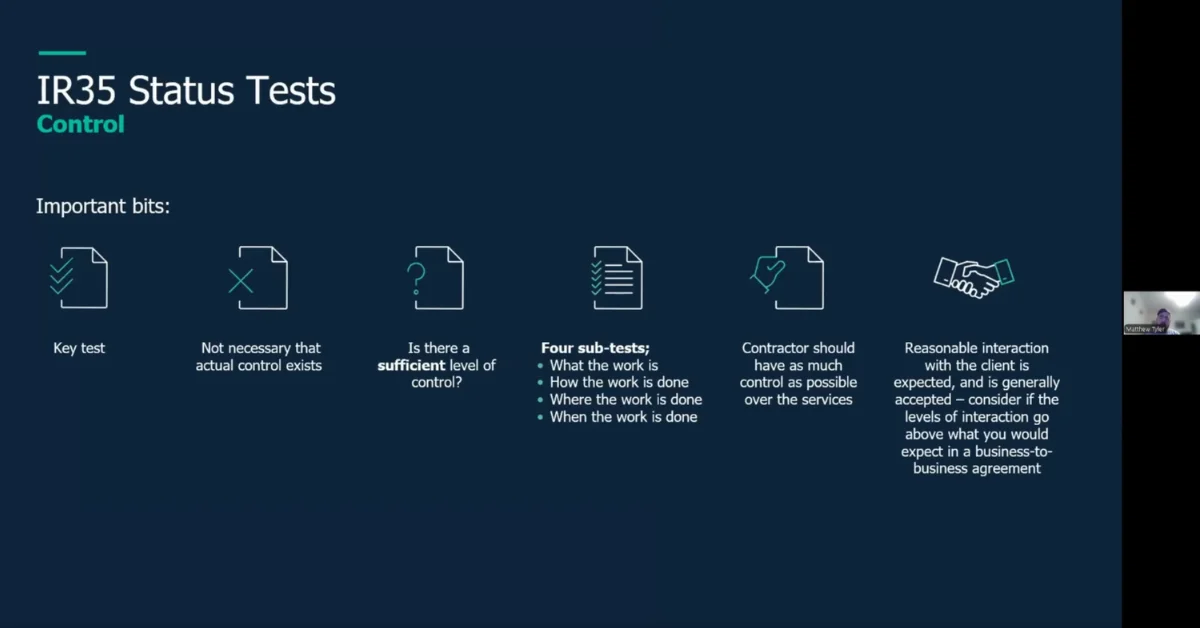
Control looks at how much direction the client has over the contractor, including what work is done, how it is completed, and when and where it takes place. While clients will naturally define project outcomes, excessive control over how work is performed can point towards an employment relationship. Contractors should generally retain autonomy over their methods and delivery.
3. Mutuality of Obligation
Mutuality of Obligation refers to whether the client is obliged to provide ongoing work and the contractor is obliged to accept it. A typical contractor engagement should be project-based, with clearly defined deliverables and an agreed contract duration. Open-ended arrangements or ongoing obligations can create employment-like characteristics.
The Importance of “Reasonable Care”
Under the off-payroll rules, end clients must demonstrate reasonable care when determining IR35 status. Failure to do so can result in tax liability transferring back to the end client, even if another party in the supply chain would normally hold responsibility.
Reasonable care may include conducting structured IR35 assessments, using appropriate tools or professional advice, documenting the decision-making process, and issuing a clear Status Determination Statement (SDS). Taking these steps helps demonstrate a responsible and compliant approach.
Joint and Several Liability (JSL): What’s Changing in 2026
A major new development for businesses engaging contractors through umbrella companies is the introduction of Joint and Several Liability, expected to take effect from April 2026.
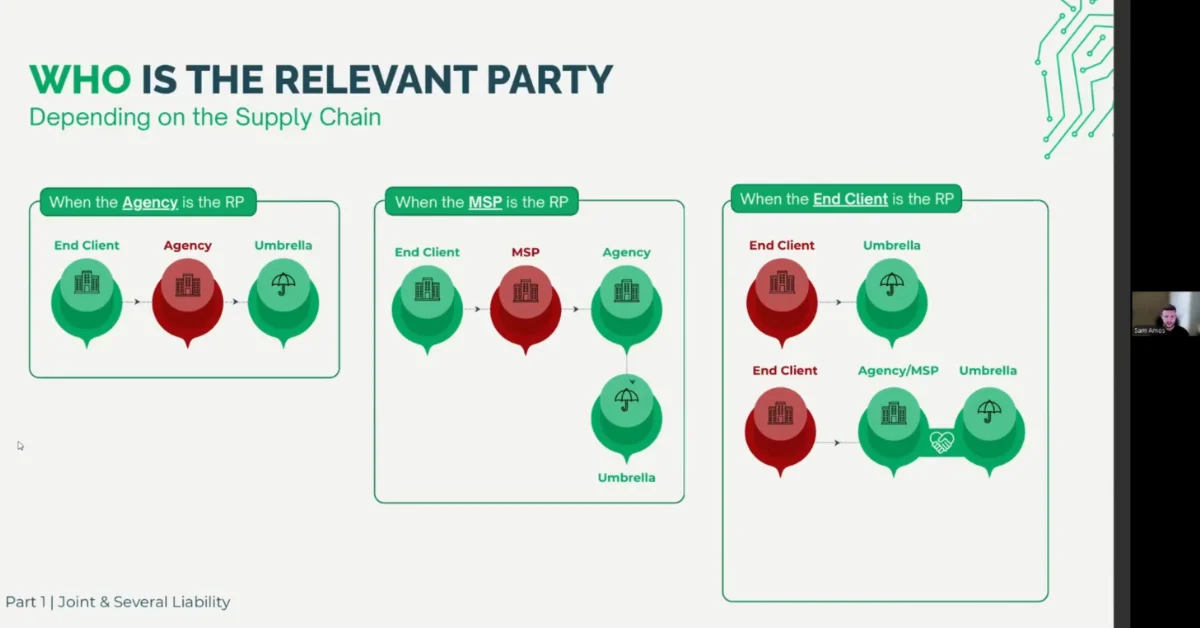
This legislation targets situations where umbrella companies fail to pay the correct PAYE tax and National Insurance to HMRC. If tax is unpaid, HMRC may recover the liability from other parties in the contractor supply chain, including recruitment agencies, Managed Service Providers (MSPs), and in some cases, the end client. Importantly, there is no statutory defence.
“There is no statutory defence... so even if you have done checks, that liability can still pass up the supply chain to the end client.”
— Sam Amos, SafeRec
This significantly increases the importance of supply chain transparency and compliance monitoring. 
The Growing Risk of Non-Compliant Umbrella Companies
The contractor market has seen a rise in “purported umbrella companies” — organisations that present themselves as compliant employers but fail to operate genuine PAYE structures. These models may involve artificially inflated take-home pay claims, complex or opaque payslips, unclear employment structures, or tax treatment that cannot easily be verified.
As Sam Amos highlights, a lack of transparency from agencies should be treated as a warning sign, as it may indicate underlying compliance risks within the supply chain. For businesses engaging contractors, this creates a real risk that tax liabilities could pass up the supply chain under JSL legislation.
Why Supply Chain Compliance Matters
“…if you don't understand your supply chain, you can't mitigate the risk… businesses need to understand exactly who the agencies are, and what umbrella companies the agents are using, so they can understand where their risk falls within those supply chains.”
— Sam Amos, SafeRec
With increased regulatory scrutiny and the introduction of Joint and Several Liability, businesses must take a proactive approach to compliance. This includes ensuring contractor supply chains are transparent, umbrella companies operate genuine PAYE models, taxes are correctly calculated and paid to HMRC, and ongoing monitoring is in place.
Technology solutions such as SafeRec provide an additional layer of assurance by auditing payroll data and verifying that taxes linked to specific contractors have been paid correctly. This level of visibility can play an important role in reducing risk.
How Spectrum IT Supports Contractor Compliance
At Spectrum IT Recruitment, we recognise that contractor legislation is becoming increasingly complex for organisations to manage.
That’s why we are committed to working with trusted and compliant supply chain partners, providing compliant IR35 tools and insurance to our clients, promoting transparency in contractor payment structures, and supporting clients with clear guidance around IR35 and contractor engagement models. We also leverage technology such as SafeRec to help strengthen JSL supply chain oversight.
Our aim is to ensure organisations can access the specialist contractor talent they need while remaining compliant with evolving legislation.
Looking ahead
IR35 and Joint and Several Liability are reshaping how organisations engage with contractors. Businesses that take a proactive and informed approach to compliance will be best positioned to minimise risk while continuing to benefit from the flexibility and expertise that contractors bring.