

How the Junior Tech Gap Threatens Future Growth
25 Jan, 202612 Minutes
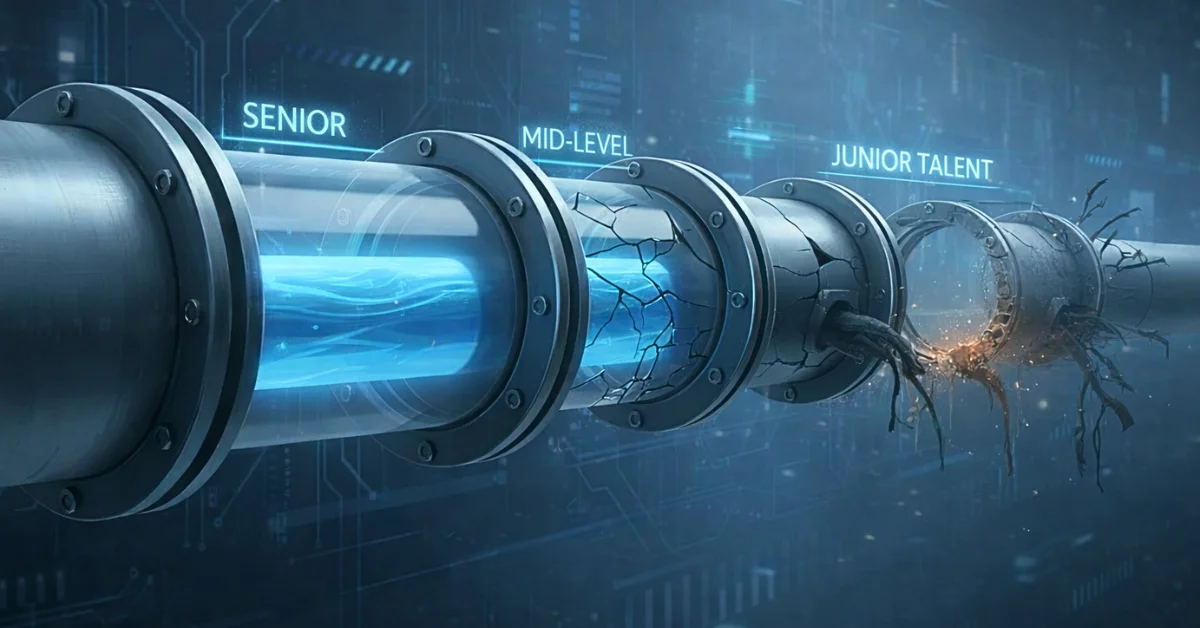
While overall demand for tech talent remains high, there’s one area that’s rapidly disappearing from job listings: junior and graduate roles. Over the last few years – and coinciding with the launch of ChatGPT in 2022 and the consequent growth and implementation of AI tech – graduates have been struggling to find suitable entries to the industry. Businesses appear to be favouring mid-level and senior hires, with even some junior roles asking for a year or two’s professional experience, in a bid to drive productivity. This reflects a wider shift we've seen across the UK tech market, where hiring has become more selective and impact-led, particularly since 2022.
This is a good strategy for immediate growth and development, but it’s short-sighted. Without junior entry points, the future technical pipeline is at risk. Companies won’t have junior or graduate employees to upskill and progress through the business, limiting innovation and hampering long-term business growth. When mid- and senior-level employees move on, who is left in the company who understands the business needs to step into those vacant positions? Graduates typically progress up the tech career ladder, moving from junior roles and advancing towards being high-level decision makers – but removing the bottom rung of that ladder destabilises this progression.
A narrowing pipeline in the tech workforce
A report published by the National Foundation for Educational Research (NFER) in March 2025 explored this “narrowing pipeline” through detailed examination of trends in the number and nature of online job adverts for tech roles in the UK since 2016. In the report, it says: “Entry-level tech roles have been particularly affected, with demand for talent more focussed at the mid and senior levels. There are now four times as many adverts for senior than junior programming roles. This raises serious challenges for younger people seeking entry to employment in tech.”
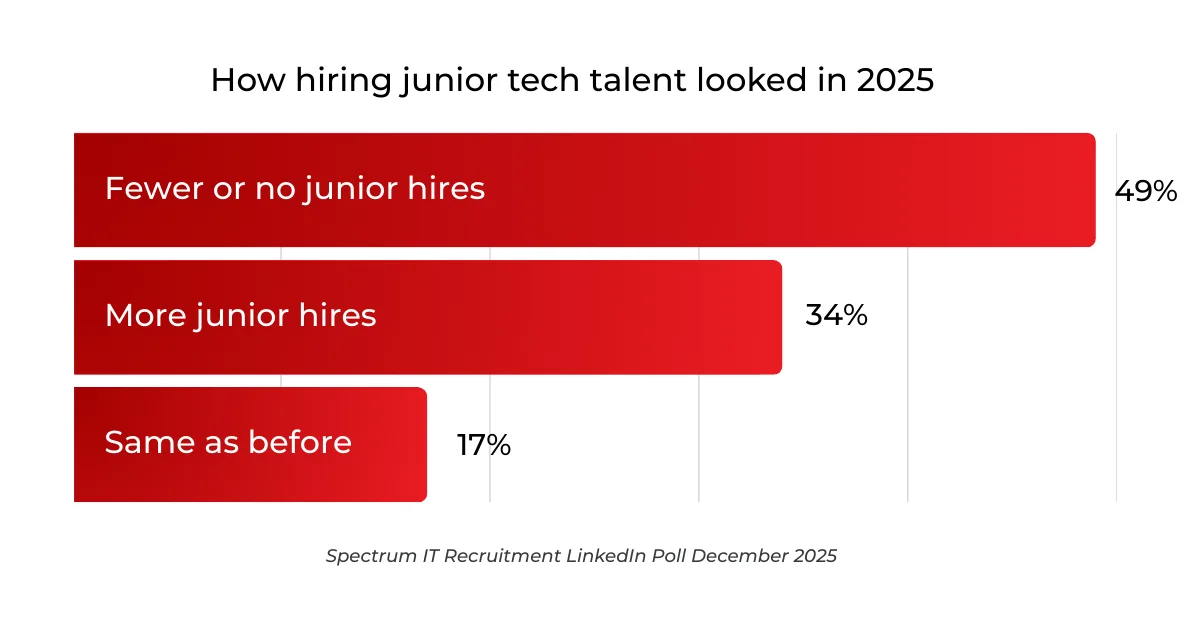
General hiring behaviours across the tech industry reflect that there are fewer graduate schemes and entry-level junior roles, with Spectrum IT's own community polling (Dec 2025) showing nearly half of employers hiring fewer junior hires or none at all. Junior roles that are available have higher expectations for ‘job-ready’ candidates, limiting opportunities for graduates looking for a first role to build their skills and experience. These decisions are not made with poor intent. Hiring more senior staff can be seen as lower risk and help companies to meet increasingly fast delivery expectations, without having to put as much time into training. When budgets are under pressure, productivity is key.
One reason attributed to this trend is the rapid adoption of AI tools that can do many of the tasks done by junior developers, for example generating code, automating testing and QA tasks, and supporting DevOps projects. This feeds into an assumption that AI can replace entry-level work altogether, removing the need to hire at this level. It could also be that businesses are holding off on entry-level roles while they understand the possibilities that AI and automation can offer their operations. With rising labour costs and National Insurance contributions, it makes business sense to reduce hires if AI tools can manage some of the workload.

However, this focus on short-term productivity carries long-term consequences. Juniors and graduates are not just today’s ‘learners’; they are future mid- and senior-level experts that give longevity and stability to business operations. Bringing in junior tech graduates means their skills can be built from the ground up, absorbing company-specific systems and ways of working. These juniors grow into competent and specialist leaders who understand business goals, while also offering continuity within teams. While AI might reduce the volume of work, it still needs human understanding, judgement and context – used correctly, AI tools can support the development of juniors, not eliminate the need for these roles.
The long-term impact of the junior role shortage
If this trend continues the way it’s going, there’s a risk of building a tech workforce that’s skewed heavily towards mid- and senior-level talent. Over time, this can lead to:
- Higher recruitment costs and longer time-to-hire for experienced roles
- Greater reliance on short-term or external hiring to plug skills gaps
- Weaker internal progression and succession planning
This means companies will be strong at the top and weak at their base. When top talent moves on for new roles, there’s inevitably a skills shortage, meaning teams need to recruit for experienced hires. There’s a lot of competition for the best talent to fill these skills gaps, so companies need to offer attractive hiring packages and remuneration.
Investing in junior staff and nurturing their skills growth builds internal talent structures. When mid- and senior-level staff move forward, the right people are already there to step into place. When you choose not to grow talent, inevitably you’ll be left having to buy that capability in later.
Eliminating junior and graduate roles has further impact within companies. It creates internal stagnation. Juniors and graduates can bring fresh ideas and out-of-the-box thinking, without which innovation can slow down and there’s a lack of diverse thinking. Teams also lose mentoring opportunities, which can limit their own progression and career growth. There’s also a lack of structured knowledge transfer down through teams.
Therefore, offering opportunities for graduates can be part of a savvy business strategy, one focused on long-term development and growth, not just immediate productivity. It’s about creating future leadership pipelines and succession planning, addressing potential skills shortages before they happen. Being proactive with training and mentorship programs builds internal knowledge bases and in-depth understanding of business systems and tools.

That’s not to say there doesn’t need to be an overhaul in junior role offerings. Developments in AI and automation are not going away, so opportunities may need to be redesigned to accommodate. Businesses should be looking at restructuring the junior and graduate pathways to better reflect the future skills the company will need and integrate those alongside AI possibilities. The most effective teams blend junior, mid and senior staff, offering resilience, stability and diversity. Running structured training programmes builds opportunities for graduates, as well as giving mentoring experience to more high-level team members.
It comes down to changing the way we view entry-level positions. It’s not about getting juniors to do the day-to-day administrative tasks and reduce the burden on other team members; it’s an opportunity to develop future talent that will enable businesses to stay competitive and innovative in years to come.
Drawing on Spectrum IT's tech hiring experience and current market trends, our consultants can help you design realistic junior roles and graduate schemes that support both immediate and delivery and future capability. Get in touch to discuss how your hiring strategy can stay competitive in the and address future skills gaps.