Hampshire AI September 2026 - Trust, Confidence, and Capability
21 Sept, 202610 minutes
AI capability is moving quickly. Building the confidence to use it well, and the trust needed to put it into real-world environments, is a different challenge altogether.
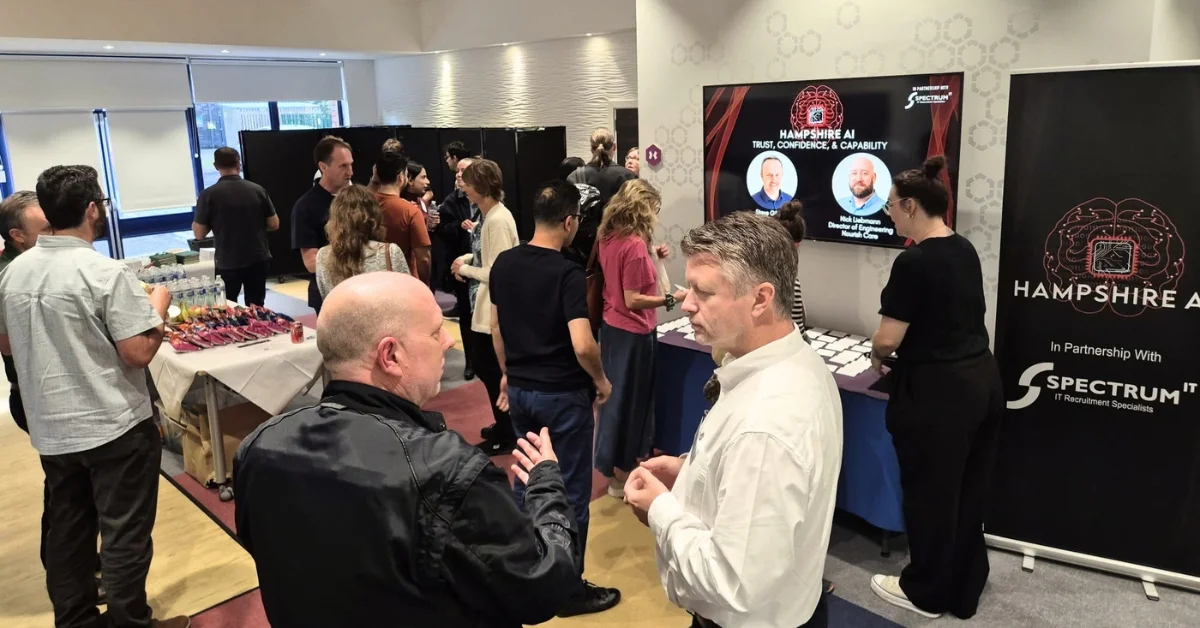
That was the focus of our September Hampshire AI event, Trust, Confidence & Capability, which brought the community back together after the summer break for an evening examining what it takes to move AI from individual experimentation into something organisations can use safely and effectively.
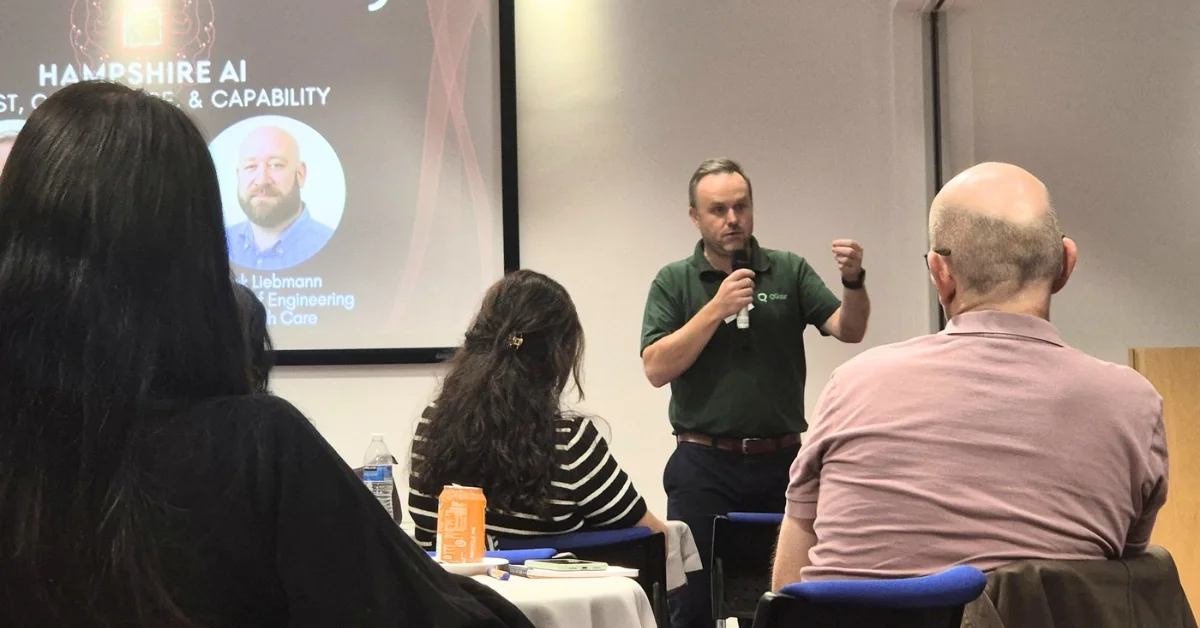
Our speakers approached that challenge from two very different perspectives. Steve Gibson, Managing Director at QGate, drew on more than 20 years of experience across change, transformation and operational excellence to explore how organisations can introduce AI into their teams. Nick Liebmann, Director of Engineering at Nourish Care, brought the perspective of social care, exploring how AI can support better decision-making in an environment where context, evidence and human judgement carry very real consequences.
Together, the two talks raised a bigger question. As AI becomes more widely used, what needs to sit around the technology to make sure it delivers something genuinely useful?
The Gap Between Adoption and Value
Steve opened the evening by looking at a gap many organisations will recognise.
AI adoption is growing rapidly at an individual level, but the same progress is not necessarily translating into organisational value. His presentation highlighted research showing that 20% of UK workers now use generative AI daily, while 46% of executives say AI has delivered little impact on profit and loss so far. Only one in ten UK organisations had successfully scaled AI into core operations.
A live poll of the room reinforced just how varied the picture is. Attendees ranged from those at the beginning of their organisation's AI journey to those already implementing it, while reactions to AI ranged from excitement to feeling overwhelmed or suspicious.
For Steve, this is partly a change challenge. Unlike many previous technology shifts, employees are often encountering and experimenting with AI in their personal lives before organisations have established how they want it to be used at work.
The opportunity is therefore not simply to introduce AI, but to harness that existing interest in a way that creates value for the business.
Getting the Fundamentals Right
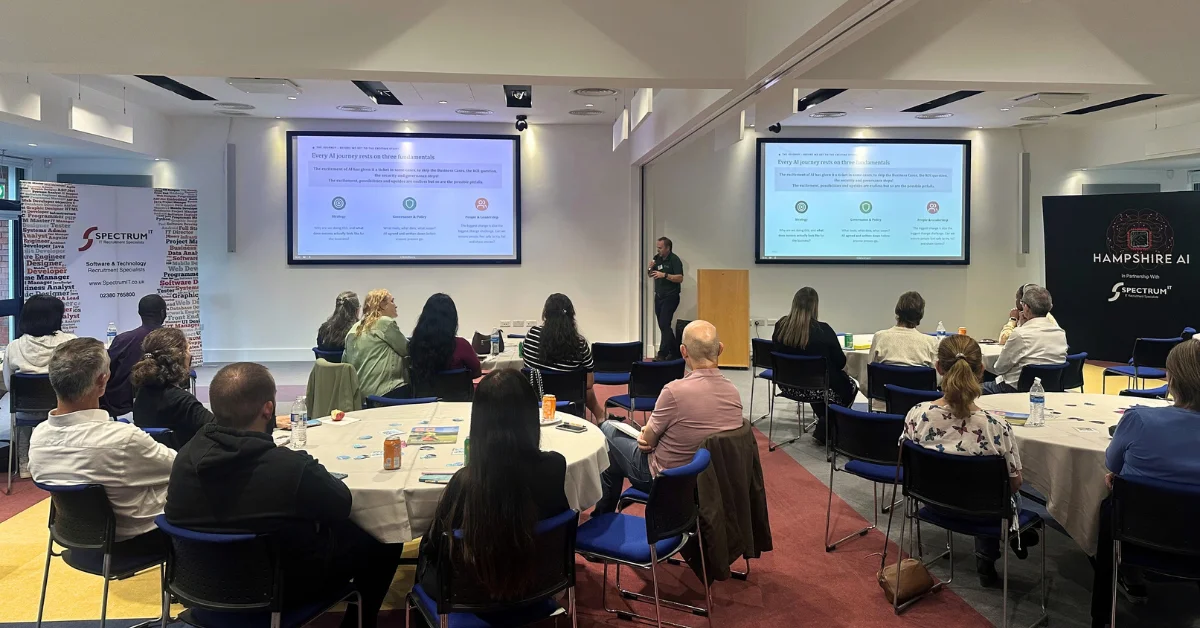
Before organisations get to the more exciting applications, Steve argued that three fundamentals need attention: strategy, governance and policy, and people and leadership.
It starts with understanding why you are using AI and what success actually looks like. Business cases, ROI, security and governance still matter. The possibilities may be new, but many of the principles organisations use to manage change are not.
Governance does not necessarily need to be complicated either. Agreeing which tools can be used, what data they can access and which tasks they can be used for gives people clearer boundaries, while uncertainty about what is permitted can itself become a barrier to adoption.
These considerations become even more important when working with sensitive information. During the audience discussion, Nick explained that the models being used are hosted within their own environment and that personally identifiable information is not passed into the AI.
Leadership also plays an important role in creating an environment where people feel able to experiment within those boundaries. Steve shared one simple example of introducing an "AI of the week" into regular team sessions, where the team could share useful applications, unusual examples and things that had not worked.
AI Can Read Everything. People Still Decide.
Nick's presentation shifted the setting from organisational adoption to social care, where he illustrated how easily important context can be lost.
In one example, different carers had recorded small changes in a person's behaviour over several days, from eating less and sleeping badly to no longer coming down to the lounge. Eleven days later, she was in hospital. Nobody had failed to record what they saw. The problem was that the individual pieces of information had never come together at the point they mattered.
That idea, context dies at the handoff, became an important theme throughout Nick's talk.
Digital care records can capture millions of interactions across areas including nutrition, hydration, medication, mobility, wellbeing and incidents. But having access to that volume of data is only the starting point. As Nick put it, its value appears when it changes a decision.
This ability to analyse information at scale creates new opportunities, but Nick was careful to distinguish capability from outcomes. AI can connect patterns across records and surface information that would be difficult for one person to process, but people still decide whether the evidence is strong enough to change someone's care and what action should follow.
That distinction becomes particularly important in high-stakes environments, where the consequences of a decision can be significant. Recommendations need to be traceable back to their evidence, while care information cannot exist in isolation from the wider ecosystem of GPs, hospitals, pharmacies and other health services.
Nick framed the question simply: it is not only can the model do it? It is also who bears the consequence if it is wrong?
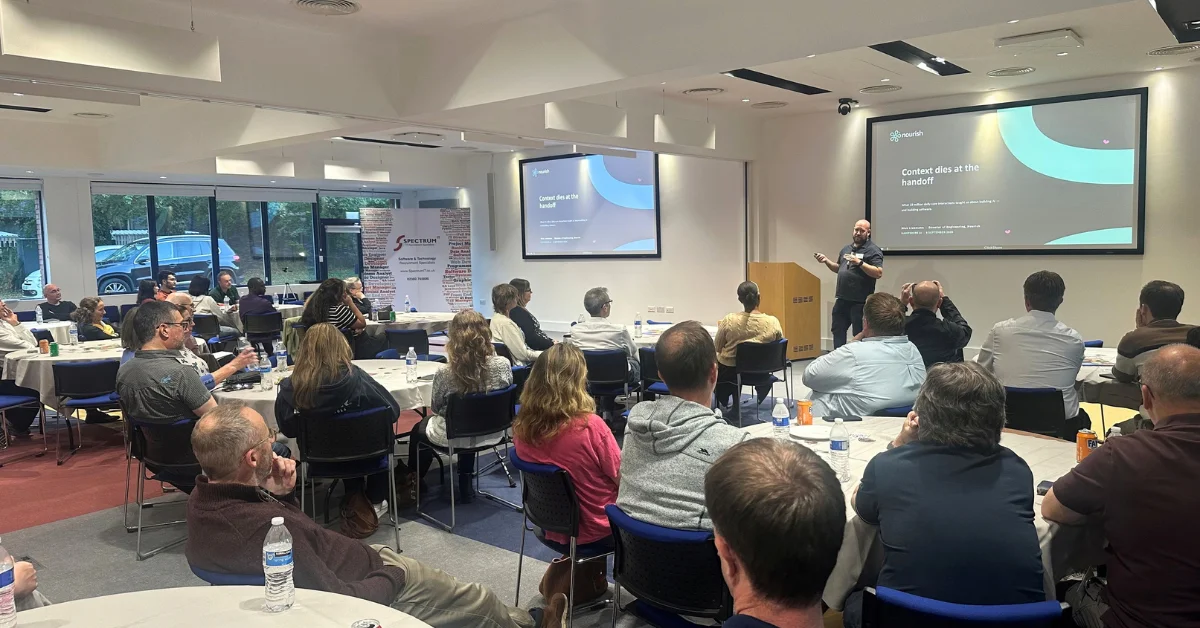
The role of human oversight came up again during the audience questions. Nick explained that AI is being used to present information and recommendations to care professionals, with human oversight remaining an important part of how that information is interpreted and used.
A Faster Process Can Still Be a Broken Process
Nick then turned the same lens back onto software engineering.
Like many development teams, they had introduced AI across discovery, design, build, testing, release and support. Each individual part became faster. The whole system did not.
Work still waited for the next person. Decisions had to be re-explained. Context was condensed into documents. Reasoning that had been clear at the beginning of a project became weaker as it moved through the development lifecycle.
As Nick summarised it, they had "accelerated the parts, not the system."
For AI, that missing context becomes particularly important. A person can recognise that something is missing and ask a question. A model only knows what it has been given and can fill a gap with an answer that sounds convincing.
Nick shared how they are now working towards an approach that can carry verified facts, assumptions, open questions and decisions through the development lifecycle. The aim is not simply to make every stage faster, but to preserve the reasoning behind decisions from discovery through to live monitoring. It reinforced a theme running throughout Nick's talk: having the information is not enough if the context around it gets lost along the way.
Capability, Confidence and Trust
The audience questions brought many of the themes from the two presentations together.
How should businesses decide which AI use cases to prioritise? Steve's answer was to resist treating AI differently from other investments. Consider cost, risk, implementation difficulty and potential impact, then identify opportunities where meaningful value can be delivered without unnecessary risk.
How do teams cope with a technology landscape that seems to change every week? Both speakers returned to people. Steve argued that leaders need to give teams permission to focus rather than chase every new release, while Nick described creating space for engineers to experiment and learn from one another without immediate delivery pressure.
And what happens to people's roles as AI takes on more work?
The examples shared during the evening suggested something more nuanced than simple replacement. Steve described organisations using AI to remove repetitive tasks so experienced people can spend more time on the work where their skills are most valuable.
Nick raised another consideration from engineering: efficiency cannot come at the expense of people understanding the systems they are responsible for. That balance sat at the heart of the evening.
Models are becoming more capable and accessible, but capability alone does not create confidence, and confidence cannot simply be declared as trust.
Nick described confidence as knowing what a system did, why it did it and being able to demonstrate that through evidence. Trust is what others give you when you do that consistently.
Steve approached the same challenge from an organisational perspective. Set clear boundaries, give people permission to experiment, keep humans involved where the consequences demand it and, importantly, understand the problem before reaching for AI as the solution.
Across both talks, it was clear that successful AI adoption relies on far more than increasingly capable technology. Good data, governance, leadership, evidence, context and human judgement all play a role in creating the confidence to use AI effectively and, over time, building trust in the outcomes it produces.
A huge thank you to Steve Gibson and Nick Liebmann for sharing such practical and open perspectives, and to everyone who joined us and contributed questions and experiences throughout the evening.