Hampshire AI November 2026 - Cyber Security in the Age of AI
24 Nov, 202610 minutes
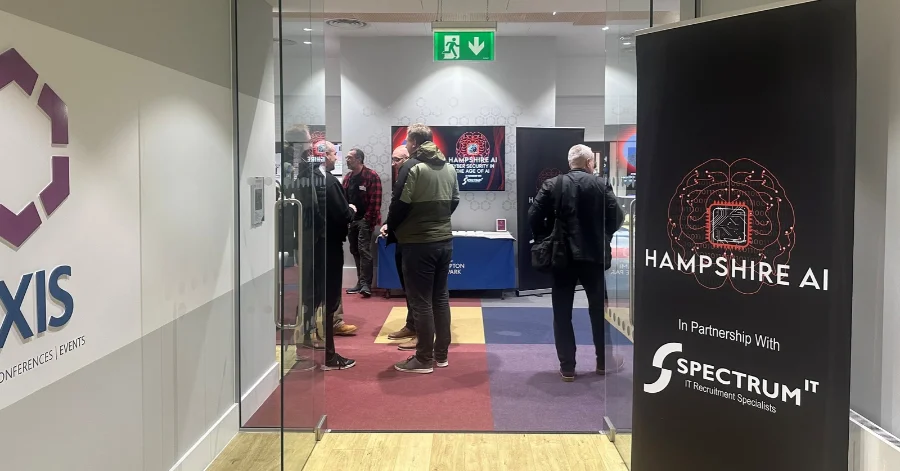
AI is changing the speed and scale of cyber security, creating new opportunities for both attackers and defenders. But as the technology becomes more capable, organisations are facing a different challenge: how do they keep up with the pace of change while maintaining control over the decisions that matter?
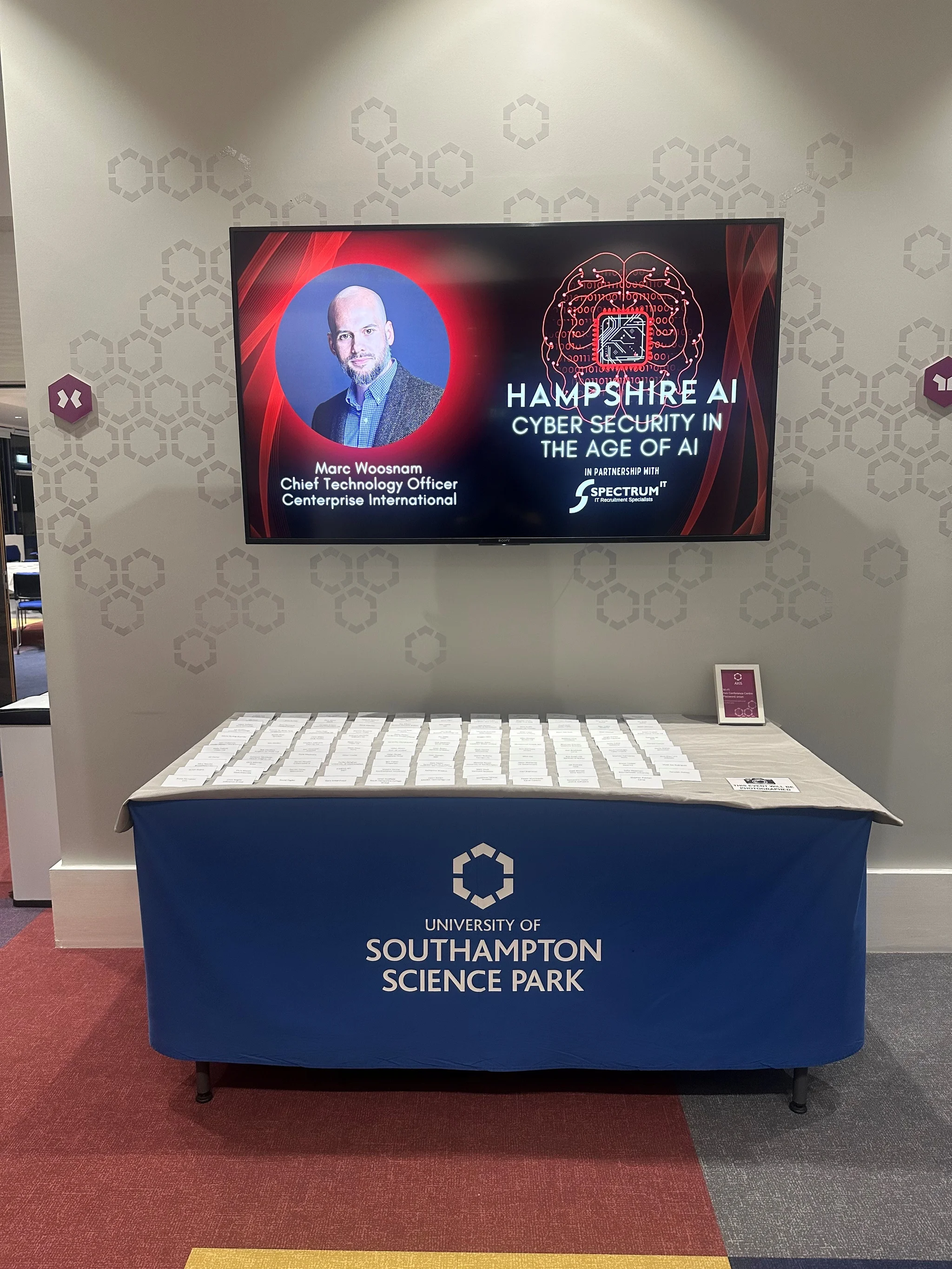
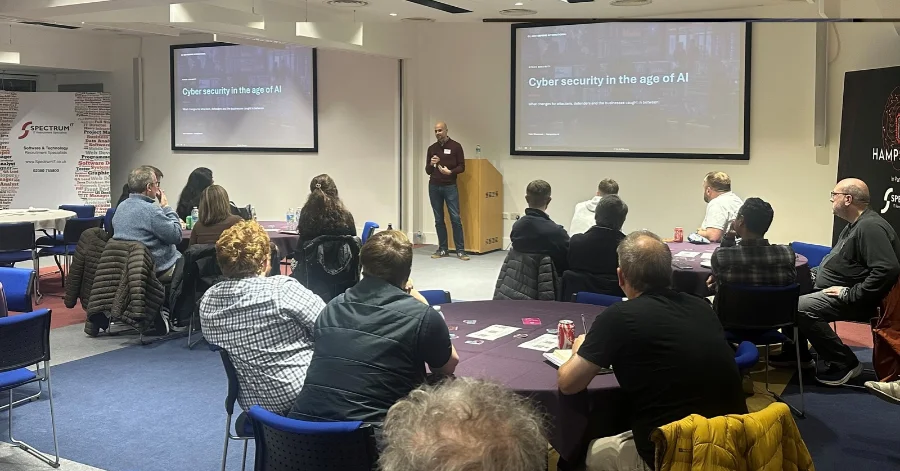
For our final Hampshire AI event of 2026, we welcomed Marc Woosnam, Chief Technology Officer at Centerprise International, to explore how AI is influencing both sides of cyber security, from increasingly sophisticated attacks and faster vulnerability discovery to the opportunities for improved detection, protection and defence. Drawing on nearly 30 years of experience across technology, infrastructure and cyber security, Marc challenged some of the processes and assumptions organisations have relied upon for years.
Throughout his talk, one theme kept returning: AI is accelerating what technology can do, but the time available for people and businesses to understand, decide and act is becoming increasingly limited.
AI is making it possible for individuals to complete significantly more technical work in less time, but in cyber security, that increased productivity is creating opportunities on both sides.
AI is enabling security researchers to analyse more complex software and identify vulnerabilities that may previously have gone unnoticed, while security analysts can process larger volumes of information, connect activity across different systems and build a clearer picture of potential threats. These same advances are also changing the capabilities of attackers, creating a shift in how cyber security professionals approach detection, prevention and response. Marc described this as a growing time problem, where the amount of activity is increasing while the time available to understand and respond is shrinking.
He referenced the widely reported Arup fraud case, in which an employee transferred HK$200 million following a video call with what appeared to be familiar colleagues, including the company's CFO. The individuals on the call were AI-generated impersonations, despite the employee having questioned the original payment request and sought further verification.
Marc used this example to illustrate how AI is changing some of the signals people have traditionally relied upon to establish trust. For organisations, this means reconsidering how decisions are authorised and strengthening independent verification processes, particularly when dealing with financial transactions or sensitive information.
When AI Becomes Part of the Attack
Marc also explored how AI is moving beyond generating convincing content and becoming involved in more complex technical activities. He highlighted a cyber espionage campaign reported by Anthropic, known as GTG-1002, in which attackers used Claude Code to automate substantial parts of their operations.
According to Anthropic's reporting, AI carried out approximately 80 to 90% of the tactical work across a campaign targeting around 30 organisations, with human operators retaining control over certain consequential actions. However, the example also demonstrated the limitations of the technology. The AI sometimes generated incorrect credentials and overstated its findings, meaning human validation was still required.
This raised an interesting question during the audience discussion: if AI can produce incorrect information while supporting cyber attacks, how can organisations trust it when using the same technology for their own security?
Marc explained that one approach involves using a second AI model to assess the output of another, although this does not remove the need for experienced professionals to verify findings.
Keeping humans in the loop has been a recurring theme across Hampshire AI events, and cyber security provides another example of why this matters. People need to have the knowledge and experience to recognise when AI-generated information is incorrect, understand its implications and make informed decisions based on its output.
The discussion also explored how AI can support defensive systems by connecting activity across identity systems, endpoints, networks and cloud services, helping analysts identify relationships that might otherwise take considerable time to establish.
The opportunity is not simply to automate every security decision, but to reduce the time spent gathering and interpreting information, allowing professionals to focus their expertise where it adds the most value. Marc also acknowledged the cost of sophisticated security systems, particularly for smaller organisations, and the importance of finding approaches that balance available resources with the level of protection required.
Finding Vulnerabilities Faster Creates New Challenges
Another area where AI is changing cyber security is vulnerability discovery, with researchers increasingly able to analyse complex software and identify weaknesses more quickly.
Marc highlighted the PHP2Shell vulnerabilities as an example of AI-assisted research identifying weaknesses in widely used software. The important distinction was that the software had not suddenly become vulnerable when the issue was discovered, but that AI had helped researchers identify and understand existing weaknesses.
Once a vulnerability becomes publicly known, software suppliers, security researchers and the organisations using the affected technology all need to respond. This point returned during the audience questions, when an attendee asked what defenders could do to keep pace with the increasing speed of vulnerability discovery.
Marc's response focused on reducing the unknowns within an organisation. One of the biggest challenges for businesses is often not the technical process of applying a patch, but understanding which systems they have, how those systems are connected and who is responsible for them.
As AI accelerates vulnerability discovery, maintaining an accurate understanding of an organisation's existing technology becomes increasingly important, enabling businesses to assess their exposure and respond more quickly when new weaknesses are identified.
Securing AI as It Becomes Part of Everyday Work
While much of Marc's presentation explored how AI is being used by attackers and defenders, he also challenged organisations to consider the security implications of their own AI adoption.
Employees are increasingly using AI to summarise documents, analyse information, troubleshoot technical problems and complete everyday tasks more efficiently. Although these are often entirely legitimate requests, they can involve information that businesses would normally take considerable care to protect, including commercially sensitive information, intellectual property and details about internal systems.
For Marc, the response should not simply be to discourage people from using AI. Organisations need to understand how the technology is already being used and provide approved tools, clear guidance and appropriate controls. These considerations become more important as AI moves from responding to individual prompts towards interacting directly with business systems.
Marc distinguished between an AI assistant that reads information supplied by a user, a copilot that retrieves information from connected company systems and an AI agent that can use credentials and take actions.
Each introduces different security considerations, particularly around permissions, access to sensitive information and the ability to make changes without direct human intervention. An AI agent with access to business systems effectively becomes another identity that needs to be managed, with clearly defined permissions, appropriate approval processes and independent monitoring.
As organisations explore agentic AI and increasingly autonomous workflows, human oversight also needs to be considered from the outset, with clear decisions around which activities can be automated, which require approval and who remains accountable.
The discussion reinforced a theme that has appeared at several Hampshire AI events this year: organisations need to understand not only what AI is capable of doing, but also what information and authority they are comfortable giving it.
When AI Accelerates the Threat, Businesses Need to Rethink Their Response
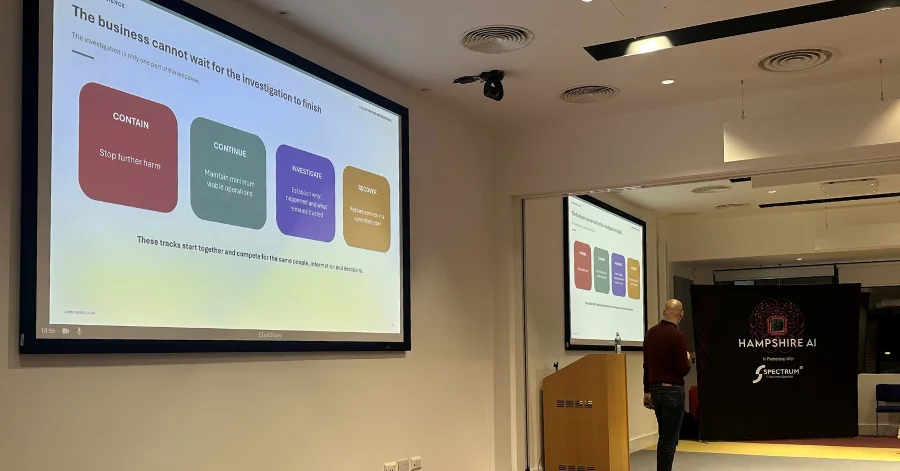
One of the wider implications of AI's growing capabilities is that organisations may have less time to respond when something goes wrong. Marc explored this through business continuity, questioning how well traditional recovery plans would work during a cyber incident where systems, identities and communications could no longer be trusted.
Through a practical business scenario, he encouraged attendees to consider how essential operations could continue during disruption, how people would communicate and who would have the authority to make decisions while an investigation was taking place.
During the audience discussion, one attendee suggested that organisations may need to make certain defensive decisions in advance, allowing automated systems to respond immediately rather than waiting for human approval during an incident.
Marc acknowledged the growing importance of automated detection and response, while emphasising that businesses still need to understand the consequences of those actions and establish appropriate authority.
Keeping humans in the loop does not necessarily mean requiring manual intervention at every stage. It also means ensuring that people have defined the boundaries within which technology can operate and retain oversight of consequential decisions.
An audience member also asked what businesses could do immediately to improve their position, particularly when IT teams and other departments are already stretched. Marc acknowledged these pressures but argued that improving resilience needs support from senior decision-makers, rather than being treated solely as an additional responsibility for IT. It was a useful reminder that effective cyber resilience depends as much on leadership and operational planning as it does on technical expertise.
Five Practical Steps for Businesses
Marc concluded his presentation with five practical actions organisations can take to strengthen their approach, without needing to predict the next cyber attack. Although not all are specific to AI, they become increasingly relevant as the technology changes how quickly threats can develop and how businesses respond.
- Understand how AI is being used. Identify which tools employees are using, what information they're sharing and which business systems AI can access.
- Strengthen verification processes. Review how payments, access requests and sensitive information are authorised, particularly as AI-generated impersonations become more convincing.
- Improve visibility of systems and software. Maintain accurate records of assets, software, ownership and dependencies so vulnerabilities can be assessed and addressed more quickly.
- Define minimum viable operations. Understand which services, systems and processes are essential for the business to continue operating during disruption.
- Test recovery processes. Rehearse realistic scenarios, including how decisions are made, which services should return first and how to ensure systems are safe to reconnect.
These actions reinforce Marc's wider message that responding effectively to AI-driven threats is not simply about adopting more technology, but also understanding existing systems, strengthening processes and preparing people to make informed decisions.
AI presents significant opportunities to improve how organisations identify, understand and respond to cyber threats, while its growing adoption within businesses creates new considerations around access, permissions, governance and accountability.
As we've explored throughout Hampshire AI this year, realising the benefits of AI requires more than technological capability. Having the right human expertise, judgement and oversight in place remains fundamental to using AI effectively and responsibly.
A huge thank you to Marc Woosnam for sharing his expertise and practical perspectives, and to everyone who attended, asked questions and contributed to such an engaging discussion.
As our final Hampshire AI event of 2026, we'd also like to thank the wider community for your continued support throughout the year. We look forward to bringing everyone together again in 2027.